Before
a movie can go into principle photography, the screenplay, or script as it is
commonly referred to, must be written up. The screenplay will hold all of the
actor’s lines, the general locations to film, and practically the whole body of
the movie. According to Movie Making
Course by Ted Jones and Chris Patmore, there are two different kinds of
scripts. One is the A/V Script format, and the other is the Master-scene
format. The A/V is usually used for commercials, as its main purpose is for
shot references. Because I’m creating a short film, I used the master-scene
format which forces whoever is reading the screenplay to read both the dialogue
and other technical ideas (20, 22).
The
first struggle I had with writing my script was coming up with a title. It’s not
extremely important to the story, however I felt as if I should establish what
this short film would be called before I started writing it. In my opinion, I
feel as if a title has a stronger meaning if it has symbolic meaning, rather
than a literal and direct meaning. I eventually came up with the name “Citrus”,
relating to how the protagonist explains the behavior of the antagonist.

In
my short-film, I tried to write it up so that it followed the Screenplay
Paradigm, or a three-act-structure. This includes the setup, the confrontation,
and the resolution (Jones and Patmore 16-17). The setup in my short film
consists of a couple fighting, and eventually the man hitting the girl. This
establishes an abusive relationship, but also that the boyfriend is extremely
hot-headed. It should effectively introduce the characters and their main
character traits. The confrontation in my project is when the main character,
Violet, stands up to the antagonist in an aggressive manner. The resolution,
taking up approximately 30-40 seconds, is Violet escaping the house she was
being trapped in.
When
writing my screenplay, I took advice from several passages within the book I’m
using during this assignment. The main point I tried to consider as writing
this project up was to leave things open. As stated in the book, “An open
script challenges the cast to create their own input…. To challenge actors
means getting each to work from his own, different, and distinct personal
identity rather than taking it from the script’s common pool. The good
screenplay leaves the director and players to work out how things will be said
and done” (Jones and Patmore 19). Another point that they make that I tried to
keep in mind was to create a film that perpetually kept the audience engaged in
what the characters were feeling. “In a moving personal experience, one is
actively involved and feels the stress subjectively. Screen drama must,
however, be structured so that characters’ inner thoughts and emotions communicate
to outsiders through the characters’ outwardly visible behavior” (Jones and
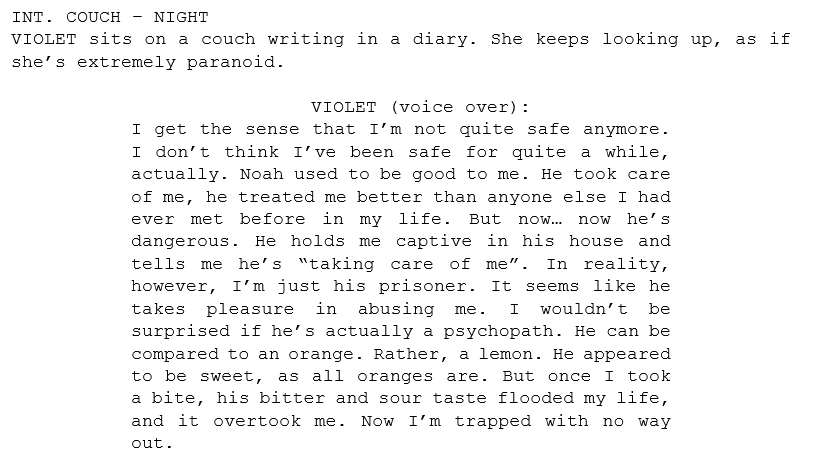
Patmore 19). My example of doing this is during a scene where Violet is
writing out a diary entry. It’s not the best way to show character’s emotions,
as I’m going against the “show not tell” rule. However, this scene is able to
communicate Violet’s thoughts and how she’s shifting from a passive and naïve character
to one who’s actively thinking about the situation that she’s in.
Through
the process of writing this screenplay, I did my best to make it as
entertaining and as interesting as possible. I tried to make it open
for my future actors to interpret their dialogue and actions in their own
unique way so that my style didn’t dominate their parts. From the section of
the book that I read from, I learned new techniques that allowed my writing to
become more professional, which would in turn benefit my story as a whole. As I
grow older and hopefully get a career in directing, perhaps these same
techniques will stay with me so that I can create unique and exciting stories
that will entertain audiences world-wide.
Now I have a question for those of you reading: Do you think that the meaning of a movie title (literal or symbolic) has an important impact on the story? Or does the title even hold much significance in the minds of the audience?
Jones, Ted, and Chris Patmore. "Good Screenplay
Essentials" Movie Making
Course, 2nd ed., Barron's Educational Series, 2012, pp. 10-13.


