Pages

Showing posts with label SAT. Show all posts
Monday, January 25, 2016

SAT Writing and Language Test: Improving Paragraphs

In my previous post I took the SAT Writing and Language Test and did not get full points. To learn from my mistakes I'm doing test corrections where I'm finding that most of my incorrect answers are about improving paragraphs. So without further ado, let's see how I can apply Mike Barrett's strategies to find the actual answers to the questions I missed!

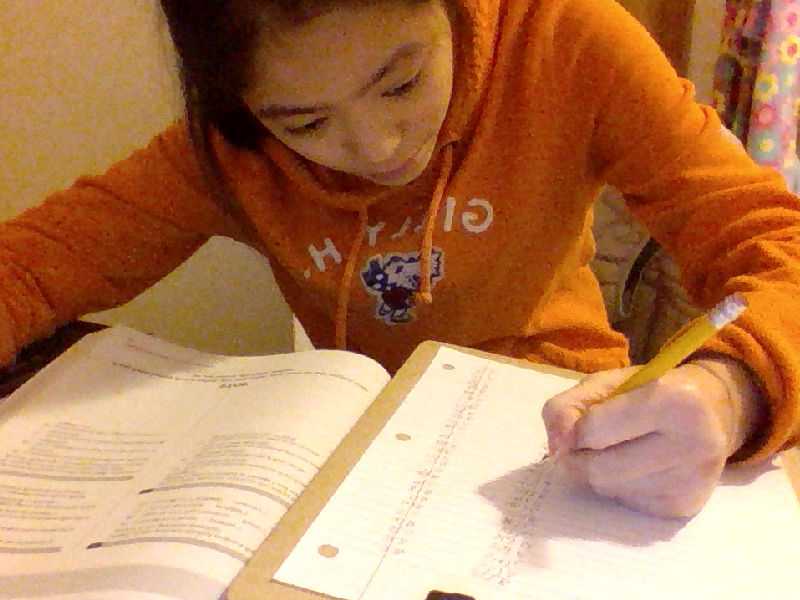
I did my test corrections on a laptop.

One question that I answered wrong was Question 2. This question basically asked me to add a relevant detail to the paragraph. I had chosen D) which elaborated on only one example. However I was incorrect as I forgot Barrett saying that you, "Add sentences that restate ideas in the paragraph and contribute the fewest new concepts" (287). The correct answer would've been B) since it gives two example which would coincide with an idea previously stated that acid whey is used by famers in many ways.
Food supplement and alternative energy is two examples that a farmer could use acid whey for; therefore B) is correct.


Another question I answered wrong was Question 22. This question asked me to reorder a sentence within a paragraph. I had chosen to not change the sentence placement (A) but this was incorrect as I didn't carefully look at all the details. The SAT Prep Black Book: The Most Effective SAT Strategies Ever Published stated that questions about getting the author's message across should be answered by looking directly at the text with no interpretation; the same solving strategy for the SAT Reading Test (Barrett 277). Looking back, D) would've been the correct answer because the sentence that needed moving refers to "crucial information," but you wouldn't know what information it talks about unless the sentence was after sentence 5.


Correcting my answers with the SAT Prep Black Book: The Most Effective SAT Strategies Ever Published  really helped me understand what the SAT is looking for on the Writing and Language Test for improving paragraphs.


When else in your life have you had to improve paragraphs? Do you think these strategies would still apply then?


Barrett, Mike. SAT Prep Black Book: The Most Effective Strategies Ever Published. San Bernardino: M. Barrett, 2013. Print.  
Sunday, January 24, 2016

SAT Writing and Language Test

The next section of the SAT I'll be tackling is the Writing and Language Test. This test is multiple choice and has much to do with grammar and writing style. Have no fear though, The Black Book: The Most Effective SAT Strategies Ever Published has all the information you'll need on how to answer problems and common patterns you'll see.
In the Writing and Language Tests there are questions that ask you to identify sentence errors and correct them. These questions solely focus on the grammar of the sentence. Mike Barrett says that something helpful to do when analyzing a sentence is to mark how words are related together in the sentence you are correcting (244). This was extremely helpful for me when I had to find the correctly conjugated verb for certain nouns/pronouns, as many sentences contained extra information between that could confuse me.

Clearly marking the subject (students) allowed me to know that the verb has to be plural (has becomes have).
Improving a sentence is also tested in the Writing and Language Test. These questions improved with an answer choice that is both grammatically and stylistically correct. So how do you know if the style is correct? This books states that a correct answer choice will fulfill certain patterns:
"Here are the 3 patterns:
  1. Shorter is better, all other things being equal.
  2. Fewer words ending in '-ed' or '-ing' is better, all other things being equal.
  3. Fewer words that are under 5 letter long ('that,' 'and,' 'as,' 'in,' 'by,' 'how,' and so on) is better, al other things being equal." (Barrett 274)
I believe Barrett meant that the most concise answer choice is the correct answer. Remembering this during the test really helped me choose an answer when I came across multiple answer choices that seemed correct.


Grammar has never been my strong suit, so I really think the SAT Prep Black Book: The Most Effective SAT Strategies Ever Published helped me achieve the score I got on the practice test I took.


Do you have any other tips on how to find errors and improve a sentence?


Barrett, Mike. SAT Prep Black Book: The Most Effective Strategies Ever Published. San Bernardino: M. Barrett, 2013. Print. 

Friday, January 22, 2016

Basic Structure of the SAT Math Test

The SAT Prep Black Book: The Most Effective SAT Strategies Ever Published was able to give me many helpful secrets and tips on the SAT Reading Test. This time I'll be using its knowledge to help me ace the SAT Math Test! After reading Mike Barrett's comments about the Math Test I applied his strategies to the non-calculator test.

To prepare myself for the Math Test I read up on what concepts would be covered in the test. Barrett states, "The concepts in the SAT Math section must be limited because of standardization. No trig or advanced stats-just arithmetic, algebra, and geometry" (Barrett 221). Already having learned these subjects, I went into the test with less anxiety. The test did not disappoint when I finished most problems with ease as arithmetic, algebra, and geometry come easy to me . However, I did answers some questions on the test incorrectly: scoring 16 out of 20. The moments I had difficulties solving problems was when I couldn't remember certain concepts since I learned these levels of math before high school. Next time, I'll definitely review he big ideas more before the test!
I struggled to remember how to solve Questions 13-15.

Along with forgetfulness, calculation errors also led to the wrong answers I had. On Question 5 I chose D) for the answer, but it was incorrect. I chose D) under the impression that it was correct because of a common pattern in the SAT Math Test: multiple choice questions have wrong answers that are similar to the correct answer (Barrett 158). All the answers seemed very similar on Question 5: they all contained x^2 and y^2 somewhere. The wrong answers seemed like right answers so I overlooked the miscalculation I had: forgetting to distribute the negative.

Knowing what concepts will be present, I will definitely review them before my next SAT Math Test; on the actual test I will be vigilant of the calculations I do and make sure they're correct.


Do you know all the math concepts on the SAT Math Test? Have you taken Algebra and Geometry class before?


Barrett, Mike. SAT Prep Black Book: The Most Effective Strategies Ever Published. San Bernardino: M. Barrett, 2013. Print. 


Thursday, December 31, 2015

Reading Test: What are the wrong answers?

In my previous post about the Reading Test of the SAT, I had revealed to you tips that are helping me as I study for this test. This included that all the answers (to the Reading Test) could be found directly in the passages and because of that a possible strategy for taking the test was to not read the passages but to only refer to them. Though this information from the SAT Prep Black Book: The Most Effective SAT Strategies Ever Published helped me greatly in taking the Reading Test, during the practice test there were still questions where I had a hard time determining the correct answer. Sometimes, to find the correct answer it may be easier to rule out all the wrong answers first. So, how can we establish that an answer is wrong?

Mike Barrett answer this question in the book by giving a brief summary of what wrong answers look like:
"Here are the most common wrong-answer patterns you'll see:
  • Answer choice contains statements that go beyond what is mentioned in the text.
  • Answer choice mentions concepts from the text but confuses the relationship between them.
  • Answer choice is completely irrelevant to the text.
  • Answer choice says the opposite of what the text says.
  • Answer choice would be a decent interpretation if you were in a literature class." (Barrett 80)
With this knowledge on plausible wrong answers, I decided to do some test corrections. Taking my practice test score-sheet (pictured in my last post) I went through my wrong answers, determining what "type" of incorrect answer it was. One needs to know their mistakes before they can fix them, right?

On Question 4 I had incorrectly chosen D) as the answer, which I can now classify as a wrong answer that is a "Valid Interpretation." This type of wrong answer is an inference that can be defended, but in the end is a guess (that may be opinionated or obscure to others) so cannot be a correct answer (Barrett 45). During the practice test I saw pieces of text that could've supported D), but when I reevaluated this question -after learning the different types of wrong answers- I realized that this topic was only ever hinted at, leaving it as an interpretation. D) was a valid interpretation but not the definite, correct answer. The right answer was A) which talked about the breaking of tradition (the inappropriate proposal), correct as it was mentioned throughout the passage and demonstrated in high importance.
This annotation shows my thoughts and reasoning for the type of wrong answer D).


My book has enlightened me on the common wrong answer choices, letting me know/fix the mistakes on my practice test. With this knowledge I will now use it to help me deduce the right answer on the next Reading Practice Test I take.


When you're stuck on a multiple choice problem, do you ever look for wrong answers to help you find the right one? Do you think this is a reliable/useful strategy?

Thanks for reading and I hope you can now spot the wrong answers on the SAT Reading Test!


Barrett, Mike. SAT Prep Black Book: The Most Effective Strategies Ever Published. San Bernardino: M. Barrett, 2013. Print. 


Monday, November 30, 2015

The Secret of the SAT Reading Test

Recently I've been thinking about my future, like what university will I be going to or what job will I get? However, to even reach any of these points in my life, I'll have to "pass" the SAT as many universities/colleges look at this test score during admissions. The goal for me on this test, is that I pass with flying colors (in the 2000s score). They always say "practice makes perfect," so what better time to get started on prepping for the SAT than now? The first section of the SAT I'd like to tackle would be the Reading Test.


In this section you read passages and then answer questions based on the text. This portion may seem tedious with all the reading and subjective with main idea based questions, but there's a secret about this test that I learned from the book SAT Prep Black Book: The Most Effective SAT Strategies Ever Published. Because this test is multiple choice, Barret says that, "The only way to talk about a text without interpreting it is to restate it without changing the meaning...In other words, believe it or not, every answer to the Critical Reading section of the SAT is spelled out somewhere on the page" (Barrett 41). When I learned this I was very surprised. But nevertheless, while I was taking one of the practice tests for this section of the SAT I kept referring back to the text as I was looking at questions.


Another factor about the Reading Test of the SAT that people may find difficult is that this test is timed. During 65 minutes you need to answer 52 multiple choice questions. In my book I learned a strategy to help save time: Knowing that every answer is within the text, one can skip reading the text if they wish. (That's crazy, right?!) The way to go about it, if you skip the passage, would be to answer all the in-text citation questions first and save the generalized questions for last (Barrett 47-48). During my practice test I applied this method, only looking at the passage for answers when the question directed me to a certain line in the text.


This strategy paired with the "secret" above really worked as I did find many answers directly on the page. When I had answered all 52 questions I had almost 4 minutes of extra time, that were optimal for checking answers.


Obviously I haven't perfected my test-taking skills for the Reading Test yet, but I'll keep practicing.


What strategy do you prefer: reading the whole passage and then answering questions or just referring back (through citations) and skipping the passage entirely?


Also, would anyone be interested if I went in depth in another post about how to answer questions on the test? (As in how to spot wrong answers and what different types of questions are asking for)


Barrett, Mike. SAT Prep Black Book: The Most Effective Strategies Ever Published. San Bernardino: M. Barrett, 2013. Print.