Pages

Monday, January 29, 2018

The Funk Masters pt 3

Papa's Got A Brand New Bag, PT 1

Papa's Got A Brand New Bag, PT 1, what a hit this song was for James Brown. Even with all the clout this song got, it wasn't always noticed as a hit,"'This is a hit!!' No it wasn't -at least not in the eyes of King Records' Syd Nathan."(Dr. Licks 26). Even James the creator of the song saw it as too slow for his taste and liking,"The original version should have been called 'Papa's Got A Brand New Drag'...The Track was deemed to slow for King's purpose and had to be sped up..."(Dr. Licks 26). But this song wasn't just a failure it was a comeback story of the century, made short and soon enough it took over."After two solid days of editing, re-EQing, and adding additional reverb and echo to the original master, Brown's indomitable vision was still wrong. It wasn't a hit. It was a monster hit."(Dr. Licks 26).


The Music

In the drum part of  Papa's Got A Brand New Bag, PT 1, which I play in the video above, Melvin Parker, the artist adapts to his same basic drum pattern as on "Out of Sight" while adding the hi-hat with more emphasis on the up beats,"This opens the door for one of Melvin's most important innovations."(Dr. Licks 18). From experience in playing his drum pattern from his song it added a new taste in style, which helped find a new way to add some sizzle to the sound as Melvin did,"The tension between Melvin's upbeat approach and everyone else's straight feel is what makes this groove sizzle."(Dr. Licks 28). 

And so on I want to leave you with a question, has there ever been a time where changing one little thing about yourself, or what you do, further your learning or style in anything?

Dr. Licks. The Great James Brown Rhythm Section. Manhattan Music.

Sunday, January 28, 2018

Proper Lifting

Currently using 50 lbs. dumbbells now.
There are many people that I have seen at the gym who either lift correctly and efficiently, or very terribly and insufficient. Michael Matthews points out two major mistakes that people make when lifting. The two mistakes are, constantly changing up your routine, and lifting like an "idiot". To start off, I will talk about changing up your routine. Matthews explains that people who believe in changing up your routine regularly often believe in the phrase "keep your body guessing". This is just complete non sense. If you want to get bigger and stronger you need to establish a strong base of muscle. You do this by repeating the same exercises every week and working your way up in weights. Matthews also mentions that, "Squats, deadlifts, bench press, dumbbell presses, and military presses. If you do these exercises correctly every week, your strength will skyrocket, and you'll gain muscle faster than you ever imagined." (23). Next, talking about lifting like an idiot. The major points Matthews mentions are lifting super heavy weights with terrible form, and going through the motions of lifting. Lifting like an idiot includes, outcomes like, "bad form can ultimately result in, wear and tear on tendons, ligaments, joints, and muscles" (Matthews 24). This is a common mistake that many people make when they first start to lift. They either think that they need to start out with lifting really heavy weights but usually ends up in them hurting themselves. Also, many people think that if they spend an hour at the gym but just go through the motions with lifting are going to accomplish their goal.
Started off using 25 lbs. dumbbells.

   I have had personal experience with all of these myths and mistakes that Matthews mentions. But as of now, I lift using correct form and have seen very positive results. What is your favorite lifting routine? Have you seen positive results?

Matthews, Michael. Bigger Leaner Stronger: the Simple Science of Building the Ultimate Male Body. Oculus Media Group Llc, 2015.


The Basic Rules of 8-Ball Pool

Hello. Today, I will be talking about the basic rules of 8-Ball Pool. It is the easiest and most widely played type of billiards.

In 8-Ball, all 15 balls are used in the game. "...the only requirements are that the 8-ball must be in the center, one corner ball must be a solid, and the other corner ball must be a stripe. The remaining balls should be distributed randomly, although this is not a requirement" (Alciatore 6).
As you can see, this is the correct setup for 8-Ball pool, according to the book.

I have duplicated the setup seen in the picture. The 8-ball is in the center, and there is a striped ball in one corner, and a solid ball in the other. The rest of the balls are randomly placed.

In 8-Ball, the main objective should be to pocket all of one of the groups (solids or stripes), then the 8-ball (Alciatore 6). This means that if the first ball you strike is a striped ball, you need to pocket the other striped balls before the opponent pockets the solid balls.

Overall, I feel that I've learned a lot about billiards from reading the book. Now that I can properly set up for a game, I feel confident that I can execute games smoothly with my friends.
My question to you is: Would you put the other balls in numerical order, or random? This also means you can arrange them according to their patterns, which may alter the outcome of the game.

Alciatore, David G. The Illustrated Principles of Pool and Billiards. New York, Sterling Pub., 2004.

Different Types of Billiards Balls

Hello. Today, I will be talking about the different types of balls used in billiards.
In Billiards, two types of balls are used, striped balls and solid balls. There is also the cue ball, which is struck by the cue stick to hit other balls. "In 8-Ball, all 15 balls are used, and in 9-ball only the balls numbered 1-9 are used" (Alciatore 6).
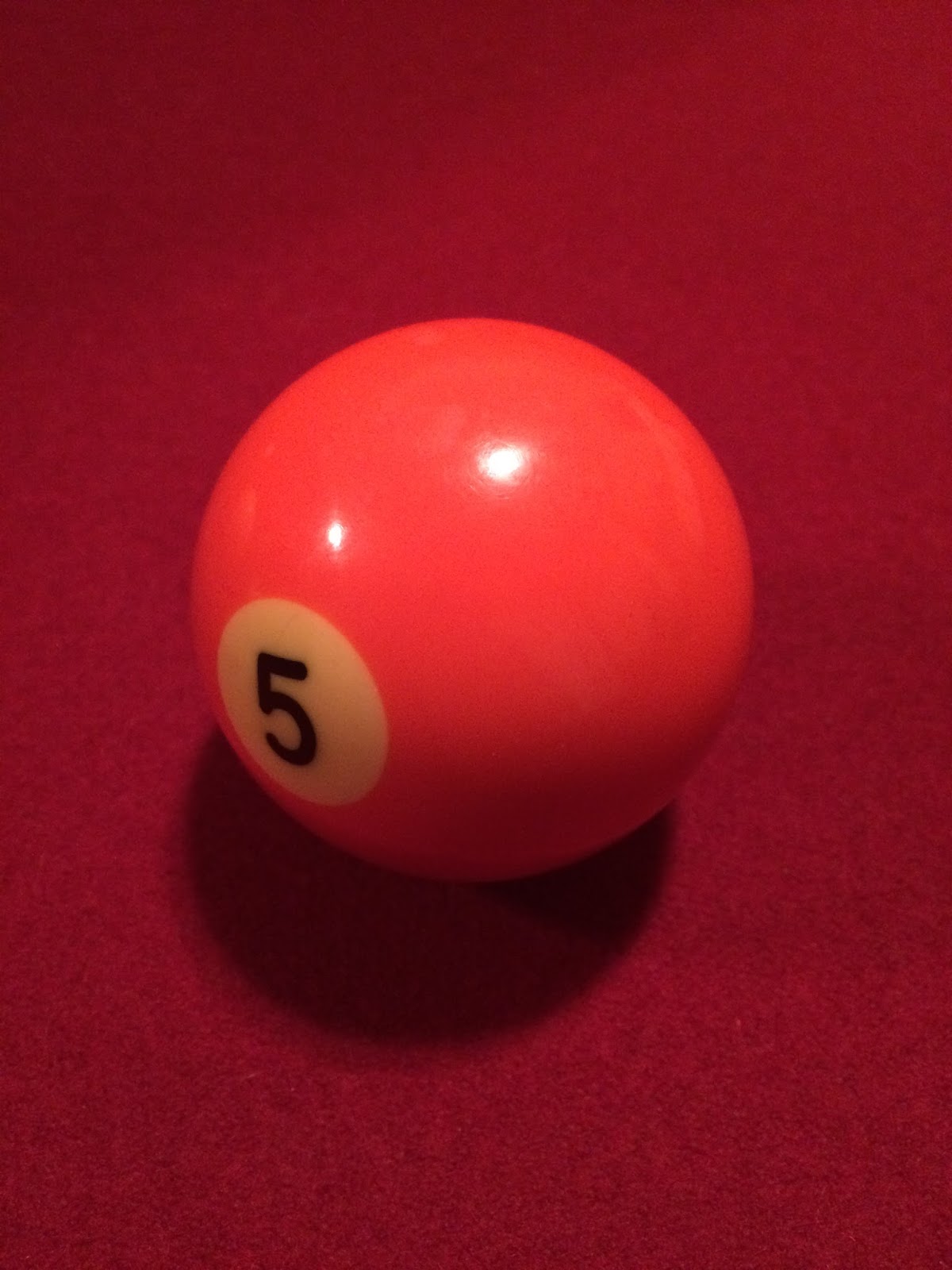
This is a striped ball.
 This is a solid ball.

In 8-Ball pool, the main objective is to hit these balls with the cue ball into the pockets. Once you have "pocketed" all of the striped or solid balls, you are ultimately required to pocket the 8-ball in order to win (Alciatore 6). I plan on explaining the rules of 8-Ball in the future.

Overall, this information has helped me in playing pool, because now that I can properly distinguish between striped and solid balls, I now can have a proper objective when playing billiards.
My question to you is: Which ball type would you go for, striped or solid?

Alciatore, David G. The Illustrated Principles of Pool and Billiards. New York, Sterling Pub., 2004.

Different Bridge Types In Billiards

Hello. Today, I will be talking about the different bridge types used in billiards. "The bridge refers to the hand or device used to support the shaft end of the cue close to the tip" (Alciatore 21).

In pool, two main types of bridges are used, the open (V-bridge) and closed bridge.
This is an open bridge. "...the shaft slides in a V-shape created by the thumb and the base of the index finger... [It] is the easiest to learn and is recommended for basic shots" (Alciatore 21).

This is the closed bridge. As you can see, my index finger is wrapped around the shaft. This constrains the stick from lifting up, and is better suited for shots that require more power (Alciatore 21).

By using these two different bridge types, you should be able to make shots of different power at appropriate times. I personally prefer the closed bridge, for it is more secure, and reduces the chance of a miscue. Using this information, I believe that I can make better and more accurate shots when playing pool.
My question for you is: Which type of bridge would you use? Would you use only one type, or use both according to the situation?

Alciatore, David G. The Illustrated Principles of Pool and Billiards. New York, Sterling Pub., 2004.

Walk Cycle

Throughout my blog posts I've talked a  great deal about walk cycles, but I've given little information about them. Walk cycles are crucial in animation, as they make up the majority of actions in any given shot, and according to Richard Williams, are "about the toughest things to do right" (102). There is a general formula that most walk cycles follow, but as Williams writes time and time again, "All walks are different...no two people in the world walk the same" (103).
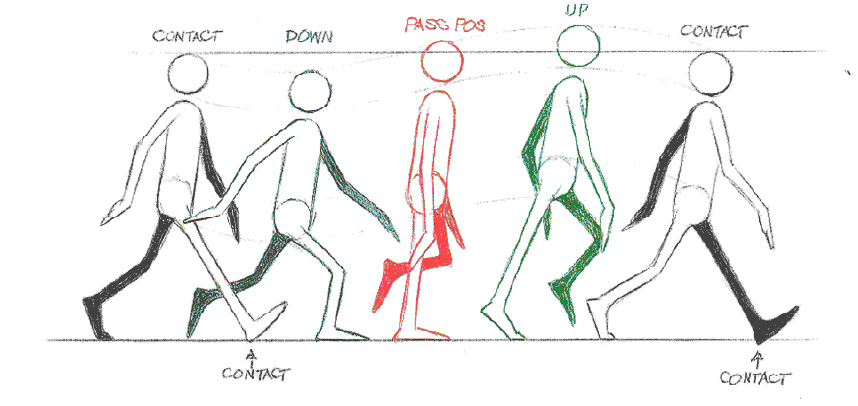
contact_method.jpg (858×406)
This is the general formula for walk cycles. If you look closely you will see a set of curved lines around the head of the walk cycle, and that line is the golden rule. Almost every cycle follows those lines. According to Williams, the above image is a "normal" walk cycle, where the weight goes down just after the step and the weight goes up just after the passing position (108).
When I tried this method, I followed the example above. The positions are labeled, and I found William's method a very easy and simple one to use. What are some things I could add to make varying walk cycles?

Straight ahead VS pose to pose

In The Animator's Survival Kit, author Richard Williams describes two types of animation: Straight Ahead and Pose to Pose.
Straight Ahead animation, as described by Richard Williams, is "[to] just start drawing and see what happens - like a kid drawing in the page corners of a schoolbook - stick the numbers on afterwards" (61). Frame by frame, an artist can work to complete the piece without worrying about the technicalities, and can include as many spontaneous twists as they would like. This method allows for a lot of artistic liberty, and can be very fun to do. On the other hand, however, this method can be wandering, messy, and inconsistent (Williams 61).
In order to try this method, I animated a simple walk cycle. Instead of planning out what I was going to do, I just began making frames and adding whatever I liked. It was very fun, but as just as Williams warned, was messy and unstructured.


The second method of animating is called Pose to Pose. In this method, the key frames are placed first, exactly where you need them. Then, the blank frames in between the key are filled with tweens. This method is far more structured than straight ahead, but it can be less fun and more predictable. Williams lists "Where's the magic?" (62) as a con, and when I tried this method I found myself agreeing.
This method, although easier to space out, felt much more mechanical and less stylized. My question is: is there a noticeable difference between the two animations?