Pages

Showing posts with label music theory. Show all posts
Monday, January 29, 2018

The Funk Masters pt 3

Papa's Got A Brand New Bag, PT 1

Papa's Got A Brand New Bag, PT 1, what a hit this song was for James Brown. Even with all the clout this song got, it wasn't always noticed as a hit,"'This is a hit!!' No it wasn't -at least not in the eyes of King Records' Syd Nathan."(Dr. Licks 26). Even James the creator of the song saw it as too slow for his taste and liking,"The original version should have been called 'Papa's Got A Brand New Drag'...The Track was deemed to slow for King's purpose and had to be sped up..."(Dr. Licks 26). But this song wasn't just a failure it was a comeback story of the century, made short and soon enough it took over."After two solid days of editing, re-EQing, and adding additional reverb and echo to the original master, Brown's indomitable vision was still wrong. It wasn't a hit. It was a monster hit."(Dr. Licks 26).


The Music

In the drum part of  Papa's Got A Brand New Bag, PT 1, which I play in the video above, Melvin Parker, the artist adapts to his same basic drum pattern as on "Out of Sight" while adding the hi-hat with more emphasis on the up beats,"This opens the door for one of Melvin's most important innovations."(Dr. Licks 18). From experience in playing his drum pattern from his song it added a new taste in style, which helped find a new way to add some sizzle to the sound as Melvin did,"The tension between Melvin's upbeat approach and everyone else's straight feel is what makes this groove sizzle."(Dr. Licks 28). 

And so on I want to leave you with a question, has there ever been a time where changing one little thing about yourself, or what you do, further your learning or style in anything?

Dr. Licks. The Great James Brown Rhythm Section. Manhattan Music.

Monday, January 1, 2018

The Great James Brown Rhythm Section

The History


"Get your white robes and prepare to baptized in holy water."(Dr. Licks pg 16). "I Don't Mind" one of the most renounced songs from James Brown in the album "Live At The Apollo" with Les Bui on guitar, Hubert Perry on bass, Clayton Fillyau on drums, and Avlin Gonder's on piano. It took almost over a year of persuasion from James to get his record label, Kings Record to publish his song due to a long history of shaky situations but a great comeback James came with,"... Live At Apollo quickly became the second best-selling album in the country."(Dr Licks pg 16). Through many comebacks in music regaining respect James still had a dirty relationship with music members,"They hung around long enough to record Live At The Apollo, but shortly thereafter fell victims to the Band's never-ending lineup changes."(Dr. Licks pg 16).


The Song


In the master score of I Don't Mind you're able to see that the time signature of this song is 12:8 time making there be 6 beats in each measure. They're soulful and full of life when played right but fall easily out of line,"12/8 ballads are musical quagmires. They can be spellbinding and uplifting when performed in the right way. In less than skilled hands, they can die a thousand deaths and make you wish you were an accountant instead of a musician."(Dr. licks pg 18). While this song is in triplet form it adds new texture while making a articulate piece to play,"When you're listening to James Brown mesmerize an audience into a trance-like state under the roof of soul music's most sanctified venue, spiritually is a forgone conclusion."(Dr. Licks pg 18). James Brown, a legend, in learning more of him do you feel he has the divine right to always replace his band members?


Dr. Licks. The Great James Brown Rhythm Section. Manhattan Music.


Monday, January 25, 2016

Music Theory: An Introduction to the Blog (Not part of Assignment)

Hello everybody!

Well, if you haven't already guessed from the name of this post, we are going to be talking about music theory. What fun!?

Well, I know that for most of you music people out there, having learned piano, or playing in your high school band or orchestra, or even being a professional composer, music theory is NOT fun.

Music theory is the enemy of fun.

Learning music theory is the equivalent of Purgatory to you.

But, it still becomes essential, to your playing, or to your compositions, and for those out there who haven't experienced the wonderful glory of music theory, your favorite songs would not exist without it.

As a kind of example, below are some short demos of songs that I have been working on, and will be releasing soon. All of these songs were built using fundamental music theory, which we will be going over the basics with this and the following blog posts please enjoy!


Music Theory: More Scales

Hello everybody and welcome back to my blog about music theory! This post will be the last one (sorry to let all my fans down) and today we will be talking about more scales!

Now, when you first saw the title of this post, if you have been following along with my posts, you probably thought, 'Oh, he is just going to show us the rest of the major and minor scales, or maybe even the chromatic scale (scale consisting of all twelve notes in an octave). I already know this stuff, so I don't need to read this post.' But that could not be farther from the truth! I assume that if you plan to get more into music, that you will put the effort in to learn all the twelve major and minor scales yourself based off of the hints I have given previously. Today, I will be sharing with you some knowledge I have gained from this book about how expansive music theory truly is.

Lets start off with the seven diatonic modes. For most of you out there, this will be completely new information, so keep reading!

"Toward the end of the 1800s... composers started to feel restrained by the key system, and they began to experiment..." (Hewitt 215). In one experiment, composers looked back to the system that existed before the keys system we use today. Then, composers were using a different set of scales called modes. Learning all of these scales will give more originality to your music.

Basically how modes work is that as the root note changes, the exact key itself doesn't really. For those piano players out there, while you were learning all of the keys and other things, did you ever try playing scales made from only the notes of the C scale? I know I did. Those are modal keys.

In more musical terms, modal scales, say from the key of C major, use all of the same notes as C major, but each key starts on a different note.

First off, there is the Ionian Mode. This mode is very well known, if not by name, as it is the exact same as the major scale (Hewitt 216). I think you understand that one pretty well now, so let's move on.

The Dorian Mode is the second modal key. In this key, the tonic is placed on the second note of a scale. This scale, if placed on a D, is very similar to a D minor scale. The only difference is that the sixth is raised by a semitone (Hewitt 217). It looks like this:
D Dorian Scale
The Phrygian Mode is next. In this key, all rules are the same, except that the root note is placed on E. This scale is similar to the E minor scale, but the second degree is flat (Hewitt 218).
The Lydian Mode starts at F,  and is almost identical to F major, except that its fourth degree is sharp (Hewitt 219).
The Mixolydian Mode starts on G, and is very similar to G major except that its seventh degree is flat (Hewitt 220).
The Aeolian Mode is another that you should know very well by now. Starting on A, this is the same as the A natural minor (Hewitt 220).
Finally, the Locrian Mode starts on B, and is identical to the B major scale, but the fifth note is lowered (Hewitt 221).
Here is a mix of all the scales in the order they are listed in with the root C played underneath all of them:


Messing around with these scales can produce some very interesting and fun results, so be sure to do that.

I personally really want to mess around with the Lydian mode, as it sounds like it would work very nicely in a future bass track.

Next I'm going to show a lot of pictures of scales from around the world. There are way to many of them for me to go into detail on every one, but they are all very fun to mess around with and could create some interesting sounds in your next track!


And here's me, making the scales for the diatonic modes sample!

Well, thanks for reading! Now our journey comes to an end. I hope you learned something while reading these, I know I learned a lot of things from this project.

Did you know that the diatonic scales existed? How did you know about them?

Hewitt, Michael. Music Theory for Computer Musicians. Boston: Course Technology,
     CENGAGE Learning, 2008. Print. 
Sunday, January 24, 2016

Music Theory: Chords

 Hello everybody and welcome back to the fun, interesting, and completely useful blog which teaches you about music theory.Today, I will be teaching you about chords!

After practicing what I have told you thus far, you may have started having ideas for melodies already. While that is amazing, a song lacks all the punch it needs if it is just a melody. In order to give your music the power it needs, you must add harmonies. That's where chords come in!

Chords are, essentially, two or more notes played at the same time, creating a harmony (Hewitt 87). The simplest form of a chord would of course be two notes played at the same time. Even just that can add a lot of depth to your compositions. But chords will be very difficult to understand without first having a basic understanding of intervals.

Whenever the human ear hears music, or any two notes played either one after the other or at the, same time, it automatically analyzes the relationship between them. "This relationship between notes in terms of their pitch--that is, how high or low they are--is called an interval" (Hewitt 63). Intervals exist in two forms. A melodic interval is the different between two notes that occur in succession. A harmonic interval is the difference between two notes that occur at the same time.

The first interval (also called unison or prime) occurs when two of the same note are played. The second, third, fourth, fifth, sixth, and seventh intervals all correspond to the notes location in relation to its scale and previous note. For example, a third interval in the C scale could be C and E, D and F, E and G, and so on. There is also an eighth interval, or octave, which spans from one note to the same note and eighth above.
(Couldn't rotate the image)
Finally, there is another type of interval, the compound interval. Compound intervals are any interval that span a distance longer than an octave. An example is a C4 to E5 interval. With that understood, we can move on to chords.

The most commonly used form of a chord, particularly in teaching, is the triad. A triad, obviously, is made up of three notes, and each has a third interval between them, in their root position (will get to that). A C major triad uses the notes C, E, and G.

'Inversions' is a word describing different note placements of a triad. Root position is the inversion in which all notes are a third interval away from each other. First inversion, in C major , would change the note order from C E G, so E G C, creating two thirds and a fourth. Second inversion moves the notes again to G C E, and now there is a third, fourth, and third.

There are many other types of chords, each using different intervals. An example is a seventh chord. This chord is built using a triad, such as C major, and adding the seventh note from the C scale, so that the notes would change to C, E, G, and B. This chord adds a different feeling to your music. Experiment with notes to find chords that work for your music.

Chords and harmony are extremely important in the music I produce. Here are some examples of the power chordal harmonies can add to your music through a song I am working on at the moment.

The main melody of the project:


This is a powerful melody in itself but...

This sounds more powerful. These notes are the melody line doubled under with other notes, creating chords and harmonies which add more depth to the song.

It even gets more powerful if you add a single harmony, such as a bass under the melody.

And you keep adding harmonies to add more and more to the song.

Finally, adding the drums gives it all the 'oomph' you need in your music.

Thank you for reading, and listening! I hope you enjoyed and will use these strategies in your life.

Can you figure out how to make a 9th chord?

Hewitt, Michael. Music Theory for Computer Musicians. Boston: Course Technology,
     CENGAGE Learning, 2008. Print. 
Saturday, January 23, 2016

Music Theory: The Minor Scale

Hello everybody and welcome back to this thing where I teach you VERY FUN music theory!! This time we will be going over something a little different: the Minor Scale.

To start off, the first minor scale you should learn is A minor, the relative minor of C. This scale is called the relative minor because it uses the exact same notes as C, but the root note is now an A (Hewitt 111).

It looks like this:
Through your practice of the major scale, you have probably realized that it sounds kind of happy, or uplifting. The minor scale is the opposite, creating a darker more somber feeling in the songs it is used in. It the A natural minor scale sounds like this:
This is a scale I use in a majority of my songs, or at least what I start with in my chord productions, although, sometimes the song switches into the relative major key, C. Also, because it has this relation to C, it is very easy to learn and practice. But if you want to learn more natural minor scales, count all of the intervals (2 1 2 2 2 2 1) and transpose them to other notes.

But that is not where the magic stops. There are two more kinds of basic minor scales! "Classical composers were dissatisfied with the way in which the natural minor mode lent itself to their purposes. Although beautiful themselves, the harmonies of the natural minor scale were not incisive enough for the dramatic kind of narrative favored by classical composers" (Hewitt 136). So came the Harmonic and Melodic Minor Scales!!!

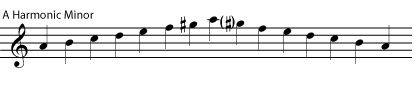
The harmonic minor scale raises the seventh note of the minor scale by a semitone. In the case of A minor this would raise the seventh G to a G#. It looks like this:
The raised seventh creates a better harmony and gives the scale a more exotic sense than the original minor scale. I remember when I was learning this scale that whenever I played it or played a song with it I was reminded of Ancient Egypt. Here is a sample:
 This scale gave composers the power they were looking for in music. This is because  when the tonic and dominant chords (will be introduced later) of the natural minor, A minor and E minor, were changed to the chords A minor and E major, they create a much more convincing cadential progression (dominant to tonic).
Natural Minor Cadence (Right) and Harmonic Minor Cadence (Left)

As you can hear, the second cadence is much stronger than the first, which is a big reason why this scale is used. Songs created using this scale will have a different impact than both the Major and Natural Minor scales, so make sure you mess around with it to see if you can change your sound.

Finally, the third kind of minor scale is the melodic minor scale. This scale can be difficult to learn at first and, taken at face value, doesn't seem to be very worth the time and effort, but it is.

Composers weren't completely satisfied with the harmonic minor scale to solve all of their problems, as that exotic sound wasn't exactly fitting for every song. To solve this, they raise not only the seventh, but also the sixth, creating a smooth rise up to the top of the scale, and on the way down, to counteract this major feeling, the minor mode was reestablished by lower the two raised notes back to their natural minor places.
Here is what it sounds like up and down:
This scale has less practical use today than it used to and plays a much larger role in theory, but that doesn't mean it is useless. This ascending form of this scale has been used by countess jazz musicians-so much so that it has been given the name the 'jazz minor scale.' Some of its chords (in a later blog) are very beautiful, and is highly used in Hawaiian traditional music. This is an effective way to spice up any of your creations.

Now you know all of the basic minor scales, adding a great deal of wiggle room to your creations, and possibly explaining the sound of some things you have already heard, played, or made. Either way, the minor scales are a huge part of bringing music to life.

As always, thank you for reading this! Bye!

Question: Which minor scale do you like the most? How, if at all, do you plan to use minor scales, and how have you used them before?


Hewitt, Michael. Music Theory for Computer Musicians. Boston: Course Technology,
     CENGAGE Learning, 2008. Print. 
Sunday, January 3, 2016

Music Theory: Note Lengths, Time Signatures, and the Score

Hello everyone and welcome back to your favorite bloggy thing about Music Theory, or however you view it. I just got back from a surprise vacation my family kidnapped me to in Oregon, so sorry if this is a little late!

Note: Did not have access to my home computer when writing this so there are no sound clips.

*********************************************************************************

Last time, we talked about the notes and the major scales and some basic fundamental notey things. Using just those things, you can already understand and write music (more complex scales will be introduced later). This time, we will give you the rest of the knowledge you need to make your own music, or decipher others: note lengths, time signatures, and the score.

First up, types of notes and their lengths. "The...way universally adopted is within musical programs is called the American way. Within this system, each note is given a value that refers to its length as a proportion of a whole note.  This method uses the terminology of whole note, half note, quarter note, and so on," (Hewitt, 42). The most commonly known note in music is the quarter note. Generally, students learn this note first, and it looks like this:

The quarter note, as stated by its name, is a quarter of something, which we will get to in a second. The second note most students learn is the half note:
This note is a half of a larger whole, and equivalent to the length of 2 quarter notes. This leads us to the third note, which makes the earlier names make sense, the whole note:
The whole note, is obviously, a full length note, and is equivalent to 2 half notes, or 4 quarter notes. With these three notes, you could easily right whole songs, especially when combined with the notes of the last post, but, there is more. Things like eighth notes, sixteenth notes, or thirty-secondth notes. Every one of these notes is marked as a quarter note, with one or more flags coming off of it, depending on how small it is:
Eighth Notes
Sixteenth Notes
There are 2 eighth notes in a quarter note, 2 sixteenth notes in an eighth note, and so on. But that isn't all either. During some times, there will be notes you wish to be places in the spaces between notes. This is accomplished by adding a dot after the notes. This dot increases the length of the note by half of its original length (Hewitt, 45). For example: A normal half note is 2 quarter notes long, but a dotted half note is worth 3 quarter notes. You can add a dot to any note to extend it by half of its length:
Dotted Half Note Equivalent

Along with all of the markings that denote when to play or make a noise, there are also symbols that tell when not to play. These are called rests, and are categorized by the same system as the notes., quarters, halves, and wholes, along with all the rest:
The Full Scale of Notes and Rests (to sixteenths)

While you now have knowledge of notes and their lengths, you still cannot write music or properly read it without knowledge of time signatures and how they work. Time signatures are indicators of the metric cycle used in a composition (Hewitt, 72). They consist of 2 numbers, one above and below. The upper number (numerator) denotes how many beats are in a measure, and the lower number (denominator) indicates what the value of those beats are. Here are some common time signatures:
Using the previous information you can start putting together rhythms and melodies to make a song, but how do you write it down? That is where the score comes in. The score, or staff, is a "series of 5 lines upon which you can place musical notes," (Hewitt, 53). This is what a blank staff looks like.
On these lines, and between them, you can place notes which correlate to the notes we discussed in the last post. But this can be a little confusing. See, there are two different kinds of staff used in general music, found together most often in piano sheet music. These are the Treble Clef and Bass Clef:
Treble Clef (Top) and Bass Clef (Bottom)
These are designed to maximize the amount of notes you can right down, as five lines and the spaces between them cannot hold all of the notes. Another way that the staff maximizes note placement is with ledger lines. Ledger lines appear on notes above or below the staff that would have appeared on a line if they had continued. The image of the scale I used in the first post used ledger lines for the first note, C.

The ledger lines connect the two parts of the staff, the bass and treble clef, as one line above the bass clef or below the treble clef is middle C. Using this you can count up and down notes through each staff and fill in the notes, to crate your own songs.

With this information you now have all you need to read others' music and to create your own. Thanks for stopping by!

Question: How will you use this knowledge?


Hewitt, Michael. Music Theory for Computer Musicians. Boston: Course Technology, 
     CENGAGE Learning, 2008. Print. 
Monday, November 30, 2015

Music Theory: The Basics

Hello Again!

In this post, we will be covering some of the basics of music theory, such as notes, scales, and other things that every musician should be pretty familiar with.

First of all, and most importantly, the notes. "The musical alphabet has only seven letters: A, B, C, D, E, F, G. Once you reach G, you return to A," ( Hewitt 21). Although the system starts at A, the most recognizable, and most used note is C. C is the white key located to the left of any group of two black keys on a piano (Hewitt 21). The main reason that C is the most important note, is because of its scale, discussed in the next paragraph. Some of you may be kind of confused, thinking to yourself, 'There is no way every song could be made with just seven different notes. and you are right, which brings me to my next point. There are notes between the notes. BWOOSH. Mind blown... or maybe not... Anyway, these notes between the main notes, are referred to as the black keys, while the main letter notes are called the white keys. The black keys are all named in relation to the white keys beside them. For example, the black key directly right of any C is called C sharp (♯), as it is the black key that is raised one up from C. This applies to every other black key. They all take their names from the keys left of them, and add a sharp. BUT, this is not always true. Indeed, if only to make this already topic even more confusing than it already was, the notes can also be named in relation to the white keys to their right. For example, that C♯  could also be called D flat (♭), and an F♯ could also be named G♭. These wonderful notes are called enharmonic equivalents, and while they may seem kind of pointless to you now, they become very important for all music that you will have to work with.

Following the logical order of things, scales are next. The C scale, particularly C major (other scales will be discussed later in the series) is widely viewed as the easiest scale to learn, and to play, well, for the piano at least. The reason for this is that the C major scale only uses the white keys on the piano, which correspond to each of the different letters of the musical 'alphabet,' starting at C, then going up the list through D, E, F, G, A, B, and back to C again. Below are a couple of the different ways the C musical scale is written, and a sound clip of the scale for those who haven't already had it ingrained into their permanent memory. Basically, for a major scale to function, you must have certain intervals between the different notes, called semitones. As you can see from the first picture of the piano roll, there is uneven vertical spacing between some notes. The pattern that every major scale uses from one note to another, going up, is 2,2,1,2,2,2,1 (the intervals between notes). Using this pattern, you can create every major scale in existence, starting on different notes. Practicing that and learning all of you scales can really help with any type of music you are going to use.

Next up is how octaves work. Once you've mastered scales, octaves should come fairly naturally to you. The concept is pretty simple. One scale of C major all fit in one octave, and when that scale reaches the next C, it has hit the next octave up. Basically, every C on the piano is in a different octave from one another, each spanning a 12 semitone difference. Using different octaves is very important in any song, so that it feels full and no two parts are too similar that they detract from each other, like having a lead guitar, bass, and a piano, all playing in different octaves. If it was all the same octave, the song would sound all messy and not as good as it would with the use of octaves. Trust me, this has been tested for a VERY long time.


Pictures... Yay!

C Major Scale in FL Studio
C Major Scale in FL Studio 12 Piano Roll

Although it may be more recognizable in the traditional notation style for those of you out there who have already gone through this torture.

C Major Scale in Traditional Notation


Here is a version you can hear.


How beautiful.

Well, I think that that is enough torture for one blog. Please join me again next time for another EXTREMELY fun, and particularly enlightening post.

Oh, before you go, I would like to know:
How do you plan to use, or already do use, this information in your life? Do you play and instrument, are into composition, or are an avid DJ who is trying to get into music production? What is your story? 
Let me know in the comments!

Bye!


Hewitt, Michael. Music Theory for Computer Musicians. Boston: Course Technology, 
     CENGAGE Learning, 2008. Print.